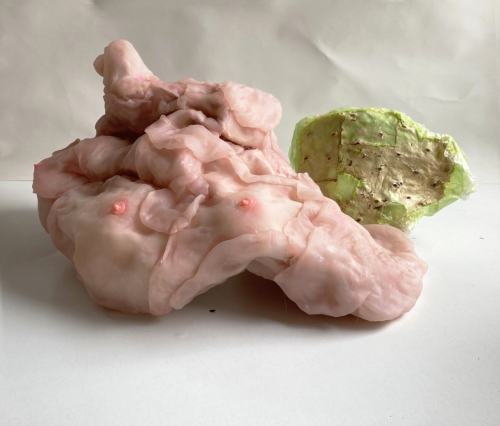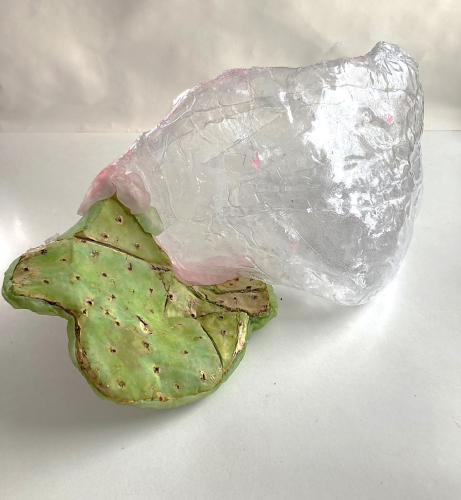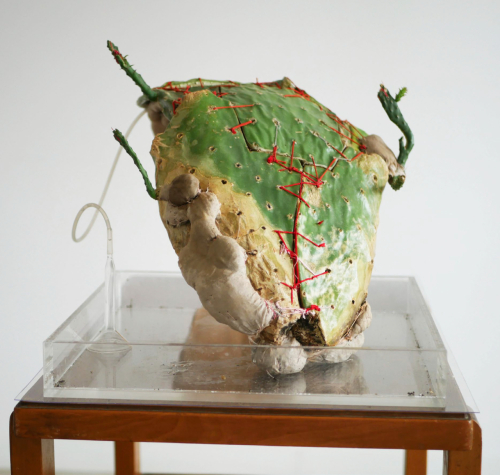
Scars
year: 2023
size cm: h70 w50 d50
price: €: ------

Katarzyna (Kasia) Proniewska-Mazurek is a Polish artist, sculptor and set designer. She teaches at the Faculty of Stage Design at the Academy of Fine Arts in Warsaw, where she runs the Puppet Theatre Set Design Studio.
Her practice moves between sculpture, stage design, bio-art and processes of organic preservation, investigating the relationships between nature and artificiality, life and decomposition, the body and matter. Working with botanical elements, biological residues, silicone, plastics and synthetic materials, she creates hybrid forms that appear to exist somewhere between organism, specimen and artificial object.
A significant part of her practice is devoted to what she describes as botanical taxidermy: a process of preserving and transforming plant matter that interrupts or slows down its natural deterioration, turning perishable material into a suspended presence. Flowers, algae, leaves, roots and other organic elements are removed from their natural life cycle and brought into contact with synthetic materials, generating forms that evoke bodies, membranes, organs or unidentified organisms.
Her engagement with the Anthropocene is particularly evident in the series Miss Venezia, which emerged from her experience of the exceptional flooding of Venice in 2019. The artist collected algae and materials left behind by the flood and transformed them into sculptural elements in which natural matter collides with human-made materials. Venice becomes not only a place but also a vulnerable organism and a laboratory for observing the effects of climate change and the transformation of ecosystems.
Alongside her visual art practice, Proniewska-Mazurek has developed an extensive career in stage design and puppet theatre, collaborating with major Polish theatrical institutions including Teatr Lalka, Teatr Guliwer and Teatr Kubuś, as well as with theatre and television productions. Her work encompasses sets, costumes, puppets and stage objects, with an ongoing interest in matter and the transformation of the body.
Her practice therefore develops at the intersection of art, theatre, nature and science, where material is not simply a medium but becomes the very site of investigation.
My work begins with observing matter at the moment when it changes state.
I am interested in processes of transformation, decomposition and preservation: what happens to an organism when it ceases to be what it was but has not yet become something else. I find in this transitional space a possibility for sculpture.
I work with botanical elements and organic residues alongside synthetic materials such as silicone, plastics and resins. I am interested in bringing together materials that belong to different temporalities: living matter, destined to decompose, and artificial matter, designed to resist. Their combination produces hybrid forms that may suggest a body, an organ, a plant or an unknown organism.
Botanical taxidermy emerged from this desire to interrupt the natural cycle of matter. I do not attempt to return a plant to life, but rather to preserve a transitional state: a moment in which the material is still recognisable, while already beginning to lose its original identity. Preservation thus becomes a form of transformation.
The use of plastic and polymers introduces a fundamental contradiction. These materials are produced by humans and can outlive organic matter by incomparably long periods of time. When they enter the sculpture together with plants, algae or other natural elements, they create a kind of impossible organism: living matter enclosed within a material that does not die.
It is within this contradiction that my interest in the Anthropocene emerges. I am not interested in illustrating ecological crisis. Instead, I look at how human intervention has altered the very substance of the world, producing new landscapes, new forms of waste, new forms of life and new forms of death.
Sculpture becomes a place of negotiation between the natural and the artificial, the organic and the synthetic, life and death. The forms I create are not necessarily intended to be recognisable. I prefer them to remain ambiguous, as if they were specimens recovered from a possible future.
My experience in stage design and puppet theatre is rooted in a similar interest. Theatre is a space in which matter can suddenly acquire a body, movement and voice. A puppet, an object or a stage form becomes alive through the gaze and through action.
In both sculpture and theatre, I work on the boundary between inert matter and living matter, looking for that fragile moment when one thing seems about to become something else.
[close]